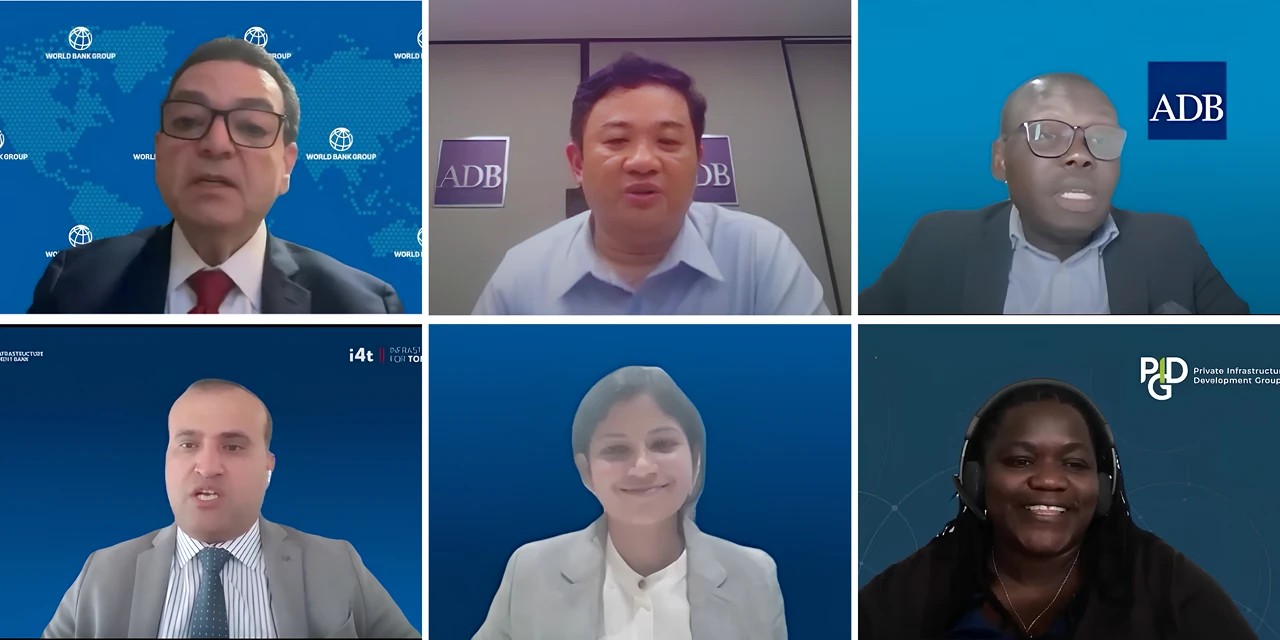
Practical approaches for strengthening occupational health and safety (OHS) in infrastructure projects were highlighted during a virtual capacity building workshop for project implementing units (PIUs), contractors, and environmental and social (E&S) practitioners, co-organized by the Multilateral Cooperation Center for Development Finance (MCDF), Asian Development Bank (ADB), Asian Infrastructure Investment Bank (AIIB), and World Bank on 24 August.
View the Recordings of the Workshop on Strengthening OHS in Infrastructure Projects
Download the Workshop Speakers’ Presentations
The workshop addressed the common challenge of translating OHS requirements into effective risk management and safer practices on infrastructure project sites. The moderator, Ms. Kisa Mfalila, Senior Advisor to the MCDF CEO on Environmental, Social, and Governance, emphasized the importance of translating multilateral development bank (MDB) OHS requirements and lessons learned into stronger project design, contractor practices, site supervision, and corrective action. A live poll led by Mr. Noel Tecson, Senior Safeguard Officer (Environment) at ADB, identified participants’ priority OHS issues.
Through technical presentations, practical exercises, and question and answer (Q&A) discussions, specialists from ADB, AIIB, and the World Bank examined how E&S standards within OHS requirements can be adopted throughout the project cycle—from project preparation and design to procurement, contractor management, construction supervision, and incident management. Ms. Brenda Omuombo of the Private Infrastructure Development Group (PIDG) facilitated the workshop’s Q&A sessions and contributed to its overall design. Below are six key takeaways:
- OHS starts before construction
During the opening session on OHS requirements in MDB-financed projects, the World Bank’s Mr. Maged Mahmoud Hamed, ADB’s Mr. Felix Nii Tettey Oku, and AIIB’s Mr. Muzaffar Ahmad said risks should be integrated into project designs and managed early. Early consideration of OHS provides greater opportunities to eliminate hazards or reduce risks at the source before construction begins, they noted.
- Procurement and contracts are critical mechanisms for converting OHS requirements into enforceable action
In a session on embedding OHS in procurement, contracts, and contractor systems, Mr. Tecson, AIIB’s Ms. Rupal Kulkarni, and Mr. Hamed explained that contractor qualifications, bidding documents, contractual requirements, staffing, and resources all play a crucial role in ensuring implementation and enforcement of OHS expectations.
- Management plans only add value when they are site-specific, adequately resourced, and effectively implemented in the field
Contractor E&S and OHS management plans need to respond to actual activities, hazards, workforce, communities, and site conditions rather than function primarily as compliance documents, explained Mr. Tecson, Mr. Kulkarni, and Mr. Hamed.
- Effective supervision means verifying that critical controls are working – not simply checking that documents exist
Particular attention should be given to controls intended to prevent serious injuries and fatalities and gauge whether they remain effective as construction conditions change, added Mr. Tecson, Mr. Kulkarni, and Mr. Hamed.
- OHS responsibilities must cascade through contractors and subcontractors and extend to both workers and affected communities
Effective risk management requires clear responsibilities throughout the project delivery chain and consideration of project-related risks beyond the construction workforce to both workers and affected communities, said Mr. Hamed and Mr. Ahmad in a session on incident and near-miss reporting, investigation, and corrective actions.
- Strong safety cultures learn from incidents by examining systemic causes rather than simply blaming workers
Incident investigation must look beyond immediate individual actions to underlying factors such as supervision, training, equipment, work planning, management practices, and organizational culture, continued Mr. Hamed and Mr. Ahmad. This approach is critical for identifying lessons that can inform corrective action and prevention, they said.
Interactive exercises allowed participants to apply these OHS principals to practical scenarios involving hazard identification, selection of appropriate controls, incident reporting and investigation, and site supervision.
Contact
David Hendrickson
Senior Communications Officer
Mobile: +86 185 0114 6758
david.hendrickson@themcdf.org