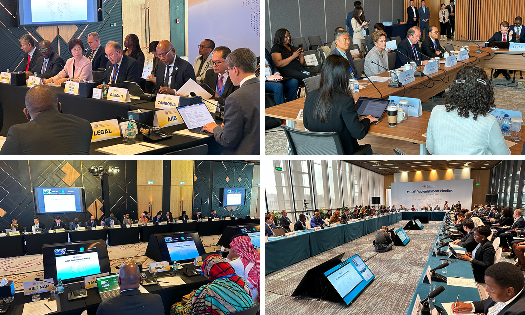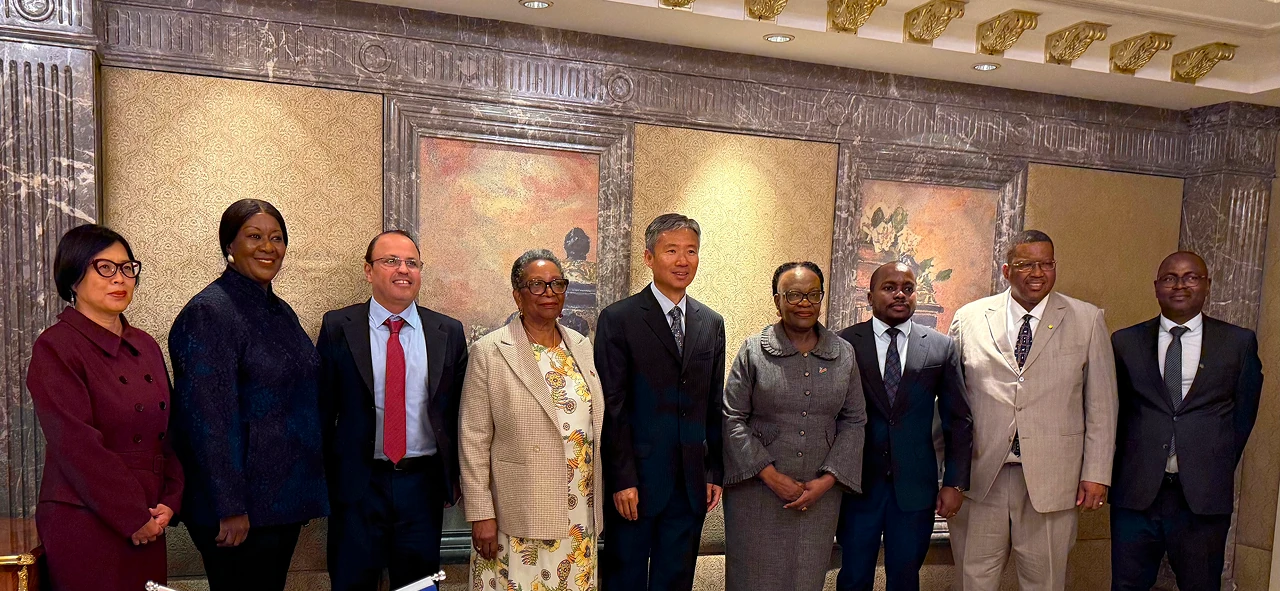
Namibia Minister of International Relations and Trade, H.E. Ms. Selma Ashipala-Musavyi, and Multilateral Cooperation Center for Development Finance (MCDF) CEO Zhongjing Wang, together with their teams, discussed avenues for accelerating cooperation to support sustainable, high-quality connectivity infrastructure development in Namibia and beyond during a bilateral meeting in Beijing on 16 April.
Minister Ashipala-Musavyi was joined by Namibia’s Ambassador to China, H.E. Ms. Tonata Itenge Emvula, and officials. The Minister described the Government of Namibia’s focus on economic diversification, resilience, and inclusive growth, with core sectors including climate-smart agriculture and food security, green energy transformation and regional power trade, water security, and transport and regional connectivity. She emphasized the country’s intention to strengthen its role as a regional trade gateway and digital economy development to raise productivity, public services delivery, and innovation. She noted that deepening cross-border connectivity is essential to linking regional value chains, lowering trade costs, and accelerating economic diversification across Southern Africa.
The Minister welcomed MCDF support for goals such as these through its project preparation grants and knowledge-sharing activities aimed at fostering the application of International Financial Institution standards and good practices within priority connectivity investments. She said that greater Namibia-MCDF collaboration in these areas is crucial for advancing bankable connectivity projects, private sector participation in infrastructure, and trade and sectoral growth, in line with Namibia’s Vision 2030 agenda.
CEO Wang, accompanied by MCDF’s Ms. Rui Mi, Mr. Bara Alaya, and Mr. Erick Mariga, indicated that MCDF has been supporting developing countries by promoting high-quality connectivity infrastructure investment, which is highly aligned with Namibia’s development agenda. He noted that Africa is a major beneficiary of MCDF support, accounting for 45% of MCDF grants since its operations began in 2021. He highlighted MCDF’s USD1.31 million grant to support the preparation of an interconnector facility project to deliver renewable energy-based power between Botswana and Namibia and link with interconnector line projects between Botswana, Zambia, and South Africa which MCDF grants are also supporting.
He added that MCDF’s more than 40 knowledge and information-sharing events have engaged over 7,700 participants from 113 countries, including Namibia, building institutional capacity for taking connectivity project investment forward across the continent and globally.
CEO Wang thanked the Government of Namibia for its trust and active participation in the first meeting on MCDF’s first replenishment of its Finance Facility held in March 2026, which discussed the operational strategy for MCDF’s next phase, starting from January 2027.
“Increasing engagement between Namibia and MCDF reflects a shared commitment to multilateral cooperation and promoting high-quality connectivity investment through partnerships,” CEO Wang said.
CEO Wang expressed his appreciation to Minister Ashipala-Musavyi for Namibia’s planned participation in the second meeting of MCDF’s replenishment exercise at New Development Bank headquarters in Shanghai on 12 June. This will provide Namibia and other participating countries with an opportunity to further shape MCDF’s future direction and priorities to maximize the benefits of its support, he said.
The discussion also covered potential areas for future Namibia-MCDF collaboration, such as the launch of the 2026 Public-Private Partnership Hot Topics Workshop Series, a planned MCDF Connectivity Infrastructure Report Series volume, and the Africa Digital Conference to be jointly hosted with the African Development Bank in December 2026.
Contact
David Hendrickson
Senior Communications Officer
Mobile: +86 185 0114 6758
david.hendrickson@themcdf.org